Speak the change.
Verify the record.
VoxBuild turns spoken site observations and photos into structured, model-linked change records. The recorder confirms the facts, the accountable reviewer makes the decision, and accepted information can move into the project's existing workflow.
For selected contractors with one live project and a named workflow owner.

A change can happen in seconds. The formal record may arrive much later.
An unexpected condition is discovered. A service is rerouted. A material is substituted. The immediate site problem gets solved—but the reason, exact location, evidence, and review status may remain split across a call, photo, message, marked-up drawing, or memory.
The issue is not only missing technology. It is the friction between the person closest to the change and the controlled project record that other teams rely on.
The site event
Work is exposed and the relevant people are present.
Fragmented evidence
Photos, voice notes, messages, and paper records hold pieces of the story.
Re-entry and clarification
Office teams reconstruct context or chase missing details.
Weak closure
The record may not reach the correct drawing, issue, model, or closeout workflow.
This workflow represents a hypothesis to validate across project types; it is not a universal description of every contractor.
Better contemporary records support better decisions—without guaranteeing the outcome.
Timely, location-specific records can support coordination, quality review, closeout, and later project analysis. Industry research shows that rework is material but varies widely by project and definition. UK building-safety policy also reinforces the importance of accurate, accessible lifecycle information for relevant regulated buildings.
VoxBuild does not claim that one tool can eliminate rework, prevent disputes, or guarantee compliance. It is designed to test a narrower proposition: can teams capture more complete field-change information sooner and route it through a clearer review process?
Rework is significant but variable
Research reports broad ranges rather than one universal percentage.
Source: Construction Industry InstituteBad data has a real cost
Bad data contributed to global rework costs in 2020; this is industry context, not a VoxBuild result.
Source: Autodesk/FMIAccurate lifecycle information matters
Guidance emphasizes maintaining accurate and accessible information for higher-risk buildings.
Source: UK Building Safety RegulatorRecords support analysis, not automatic proof
Guidance recognizes the importance of contemporary records while contractual entitlement and causation still require analysis.
Source: RICSA voice note becomes useful only when the facts are structured, confirmed, and reviewed.
A spoken observation is not automatically an approved engineering change. VoxBuild separates five stages so automation reduces administration without bypassing responsibility.
What happened on site?
Where, what asset, what action, what reason, what evidence?
Did the recorder verify the proposed fields and correct uncertainty?
Did the responsible person accept, reject, or request clarification?
Did the accepted record enter the controlled project workflow?
AI proposes. The recorder confirms. The reviewer decides.
A field-change packet built around the decision that needs to happen next.
VoxBuild proposes a lightweight field flow for capturing an observation and a structured review flow for turning it into an accountable record. The atomic unit is not the transcript. It is the verified packet.
Capabilities shown are proposed for pilot development. Availability and integrations must be verified before publication.
One observation. One packet. One clear review request.
“Level three, east riser, above corridor ceiling. The installed sprinkler branch conflicts with the cable tray. The branch was lowered about 120 millimetres. Photo attached. Please confirm whether the coordinated model and inspection record need updating.”Fictional example. Not customer data.
The recorder checks critical facts and corrects extraction errors before the packet reaches the reviewer.
The accountable role accepts, rejects, requests clarification, or routes the packet for design or quality review.
VoxBuild does not decide whether the model should change. It helps preserve what is known, expose what is missing, and send the right decision to the right role.
Easier for the person capturing the change. Better structured for the person reviewing it.
Site engineers and supervisors
Capture the observation while the work and context are visible.
MEP and trade coordinators
Turn reroutes, clashes, substitutions, and hidden conditions into clearer review requests.
QA/QC and inspection teams
Connect evidence, required fields, and status instead of reconstructing the record later.
BIM/VDC and document control
Receive accepted packets linked to the correct project context and ready for controlled incorporation.
Project, quality, and digital-construction leaders
Measure whether the workflow improves completeness, review time, and repeatability.
VoxBuild is not currently intended for autonomous engineering approval, broad construction management, continuous worker monitoring, or projects with no defined review owner.
VoxBuild should improve the information entering your project workflow—not become another isolated source of truth.
Construction teams already rely on common data environments, issue systems, drawings, BIM tools, and project controls. VoxBuild's initial path is portable output and one carefully selected integration after the workflow is validated.
Open before deep
Prioritize BCF, PDF, and CSV output before custom enterprise integrations.
One system of record
Accepted project information should continue to live where the contractor has defined authority and governance.
No implied partnerships
References to Procore, Autodesk, buildingSMART, or other systems describe potential interoperability and do not imply endorsement or current compatibility.
Prove one field-change workflow on one live project.
The proposed pilot is an 8–10 week collaboration for contractors willing to map the current process, deploy a narrow prototype, measure real use, and make a continuation decision based on evidence.
Baseline and configuration
Map the current flow, required fields, project taxonomy, approvals, and evidence measures.
Prototype preparation
Configure the field packet, recorder confirmation, reviewer flow, and portable output.
Live controlled use
Train a small cohort and support eligible observations on the project.
Evidence and decision
Analyze behavior, completeness, time, corrections, review outcomes, and continuation conditions.
- Current-state workflow mapping
- Required-field and approval schema
- Small trained recorder and reviewer cohort
- Voice/photo-to-packet prototype for one eligible workflow
- BCF/PDF/CSV output or one agreed sandbox path
- Baseline and weekly evidence collection
- Final findings and continuation recommendation
- One active project
- A named executive or project sponsor
- A workflow owner
- 5–15 recorders and 2–5 reviewers
- Access to the current process and baseline
- Permission to test with appropriately governed project information
- Weekly feedback and a final decision meeting
- Commercial refurbishment
- MEP/fit-out coordination
- Repeated hidden-condition, reroute, substitution, or field-change events
- Existing issue, drawing, or common-data-environment workflow
- Leadership willing to measure rather than only "try AI"
- No accountable reviewer
- No permission to gather a baseline or usage evidence
- Expectation of autonomous model changes
- Need for immediate enterprise-wide rollout
- Highly sensitive project with no agreed data process
- Interest only in a free custom build
Proposed targets; final thresholds depend on the partner's baseline.
Faster capture must not weaken engineering authority, privacy, or project governance.
Intentional recording only
No continuous background listening.
Human confirmation
Critical extracted facts must be reviewable and editable.
Accountable approval
VoxBuild does not authorize engineering or contractual changes.
Data minimization
Collect only the audio, visual, project, and location data needed for the agreed workflow.
Clear retention
Pilot terms must define how long source audio, transcripts, images, and records are retained.
Role-based access
Project information must be visible only to authorized people.
Visible uncertainty
Low-confidence fields should be flagged or left incomplete, not converted into false certainty.
No legal guarantees
Contemporary records may support project analysis, but do not automatically prove entitlement, causation, compliance, or accuracy.
Questions we hear from construction teams.
Capture the field change before the context disappears.
VoxBuild is looking for construction teams willing to test a narrow, measurable path from spoken observation to verified project record.
Submission does not guarantee selection. We prioritize projects with a named sponsor, clear review owner, suitable data governance, and a measurable current workflow.
See how VoxBuild turns field observations into verified records.
Each concept card illustrates a stage in the VoxBuild workflow. Click through for a detailed walkthrough.
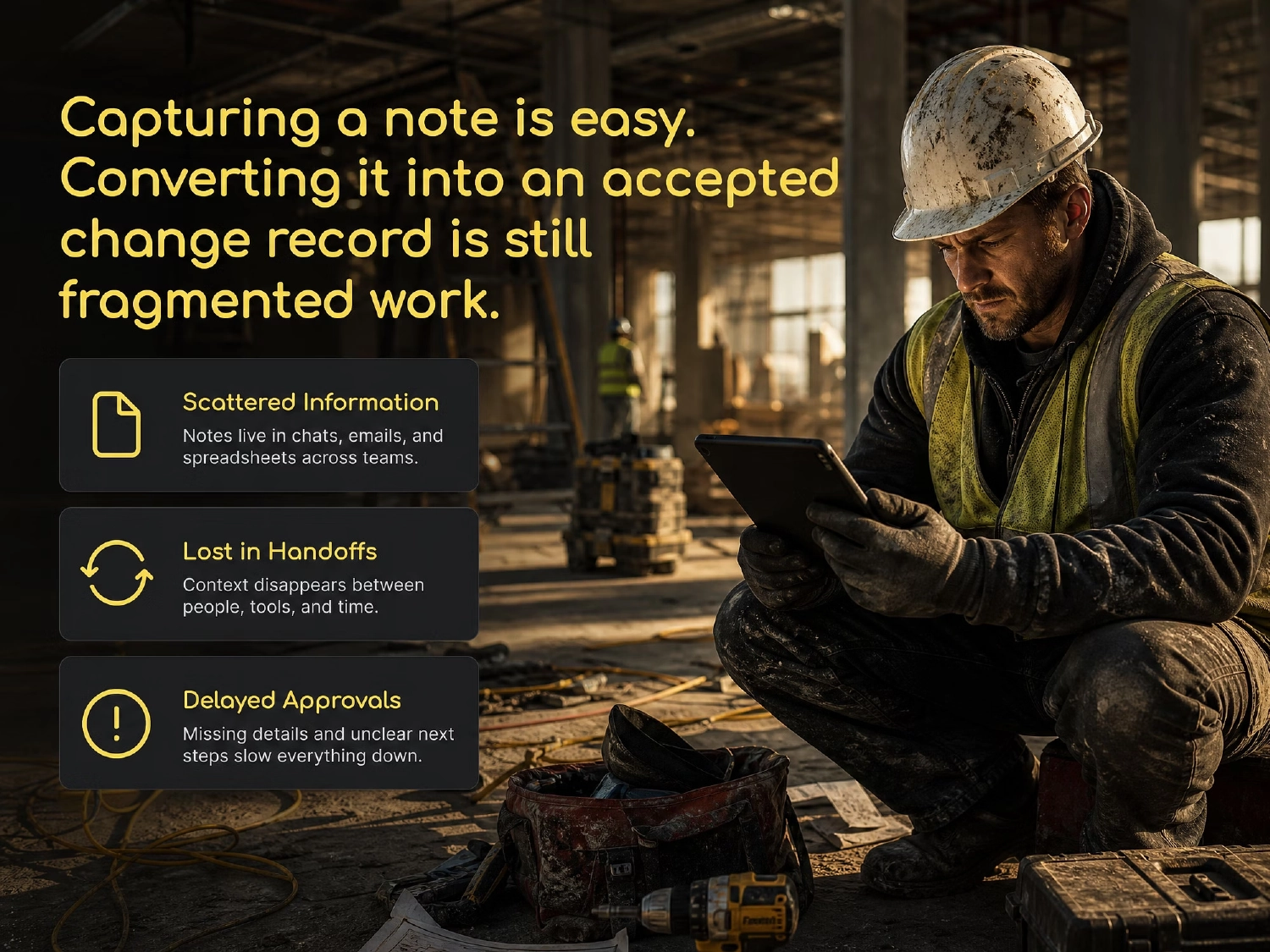
From Capture to Change
How a spoken observation becomes a structured change packet with extracted fields, confidence flags, and review routing.
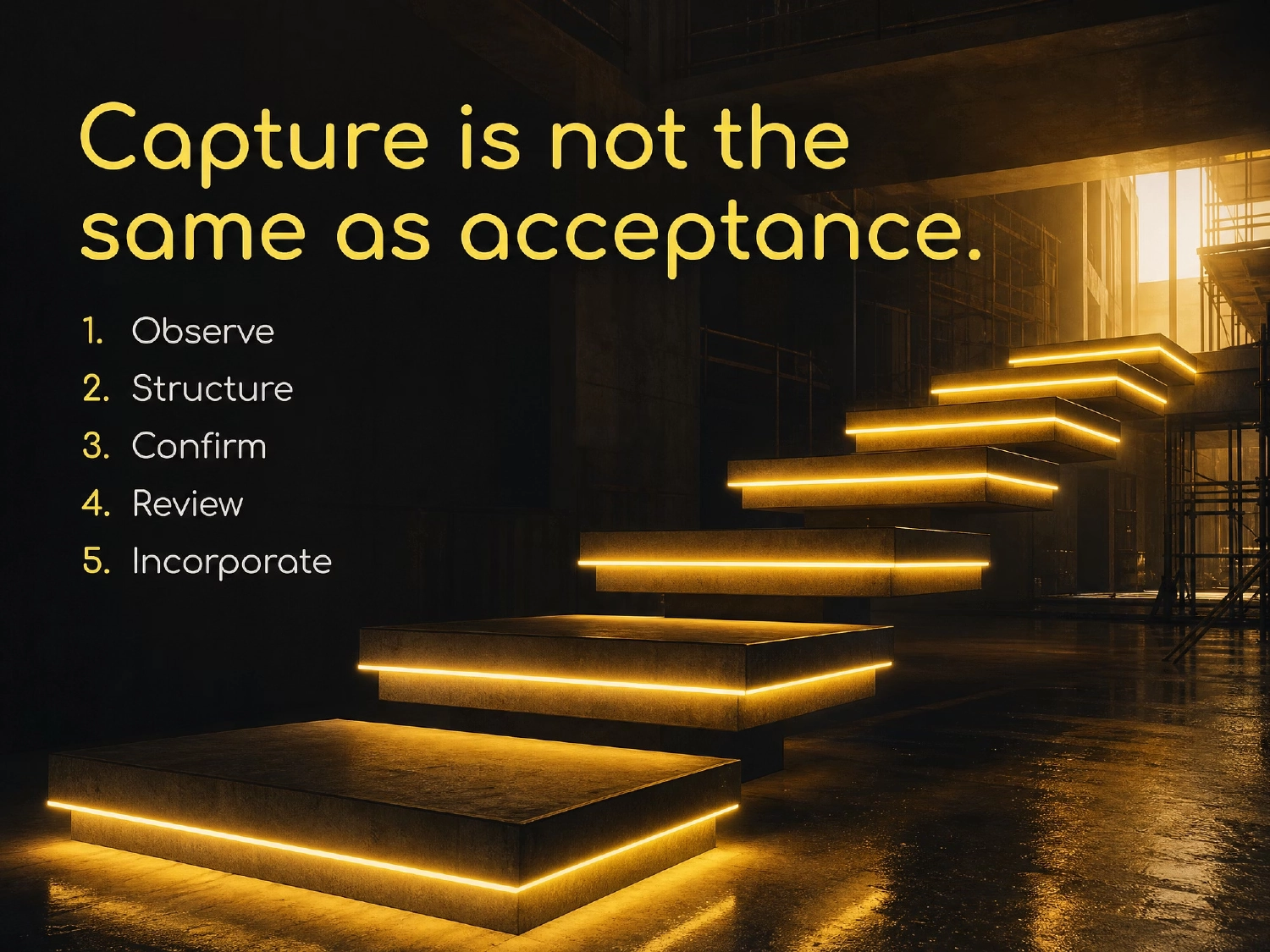
Capture to Incorporation
The five-stage pipeline: observe, structure, confirm, review, and incorporate into the project workflow.
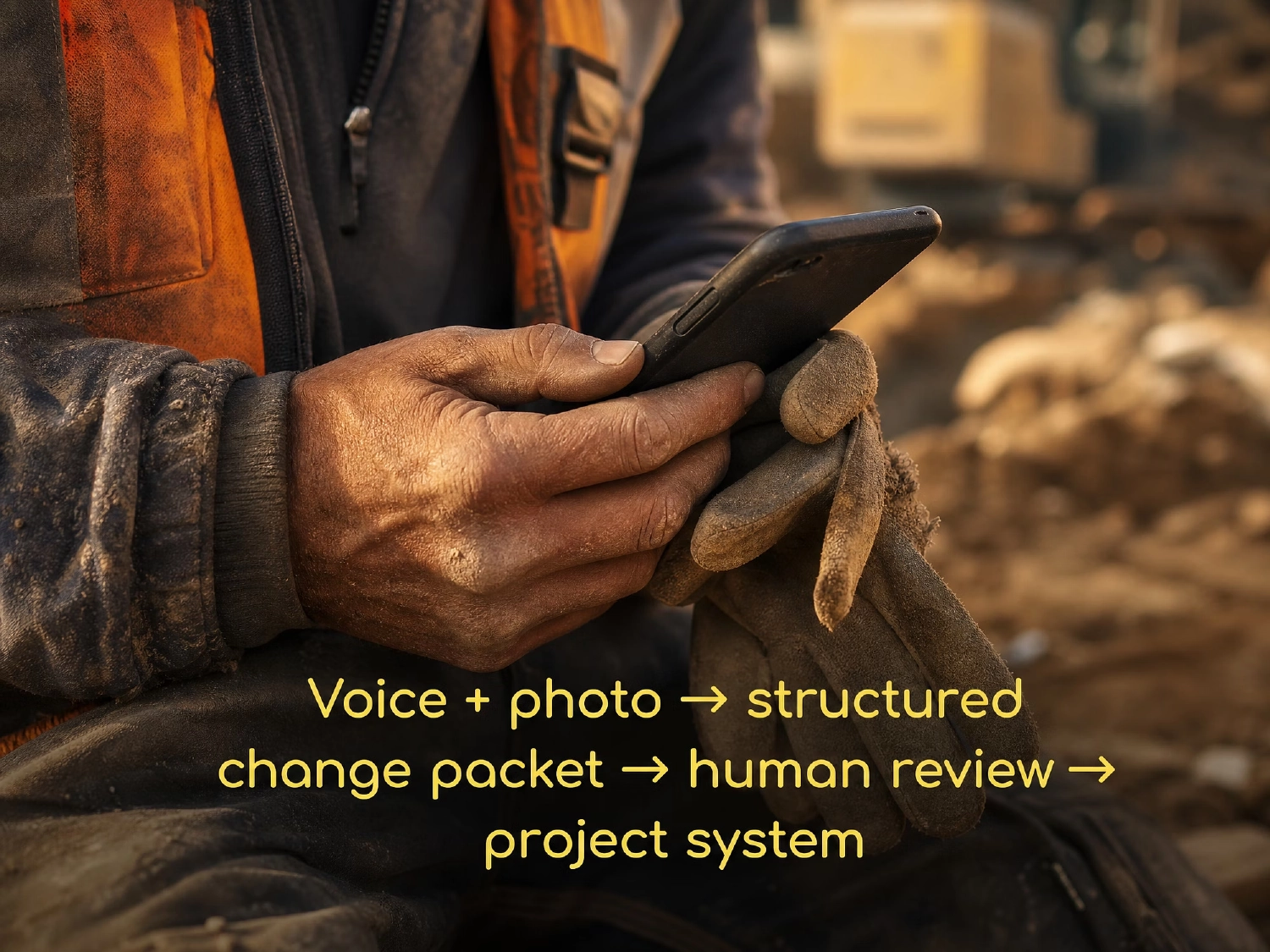
How It Works
A step-by-step view of the voice-to-verified-packet process, from context selection to reviewer decision.
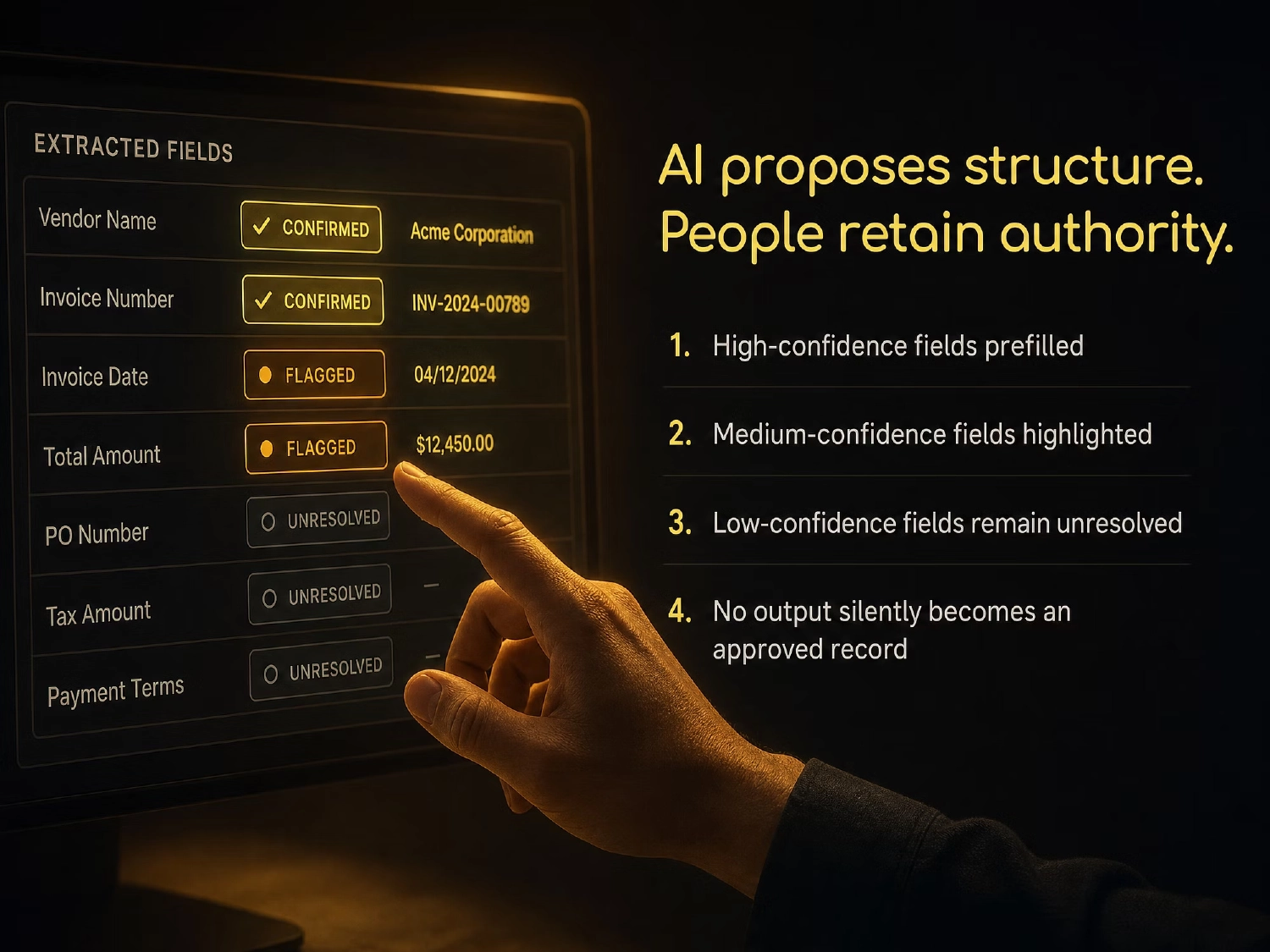
Human Over the Loop
AI proposes structure and flags uncertainty. The recorder confirms facts. The reviewer makes the decision.
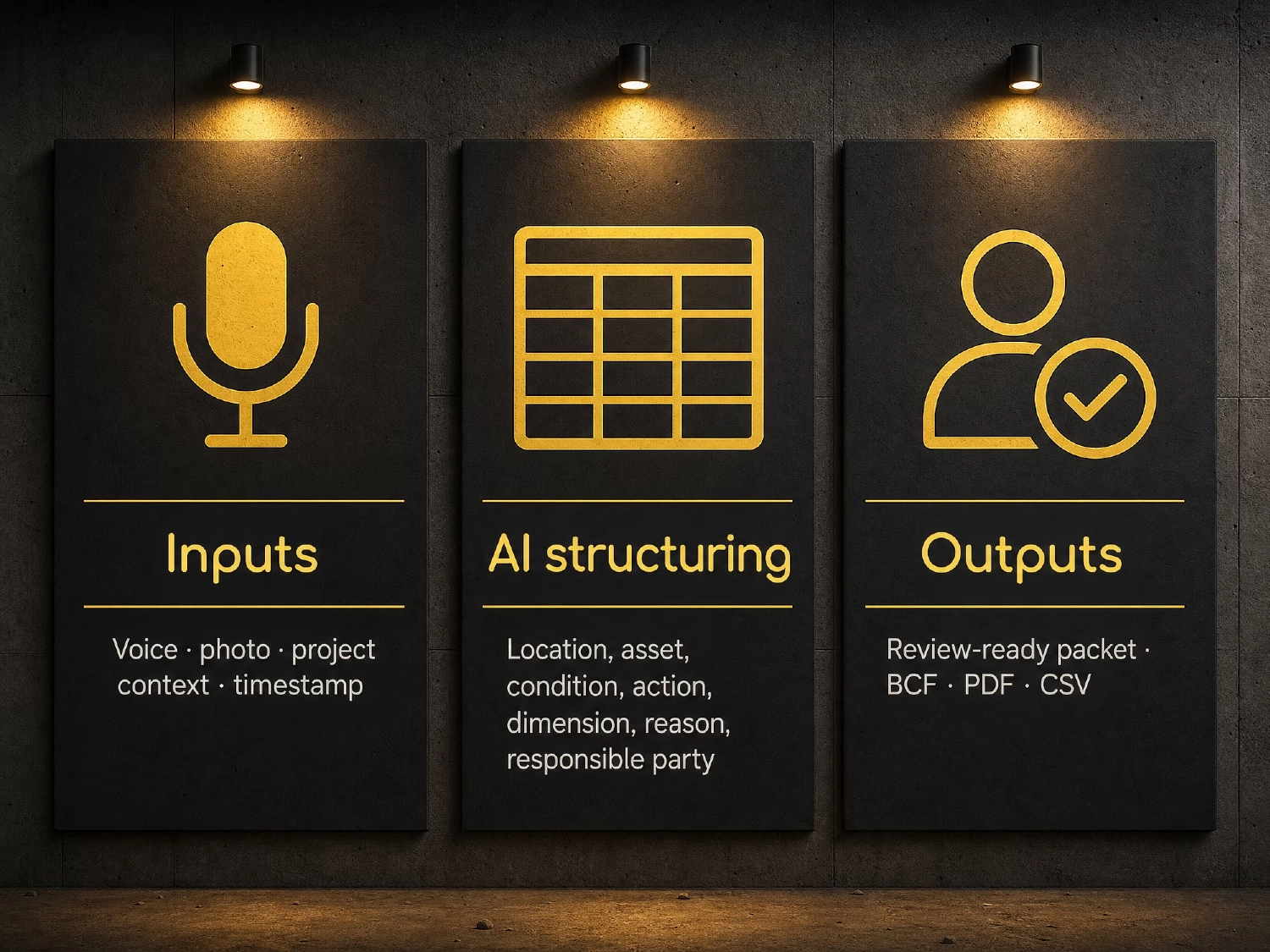
Input to Output Process
Voice and photos enter. A verified, review-ready change packet with portable output options exits.
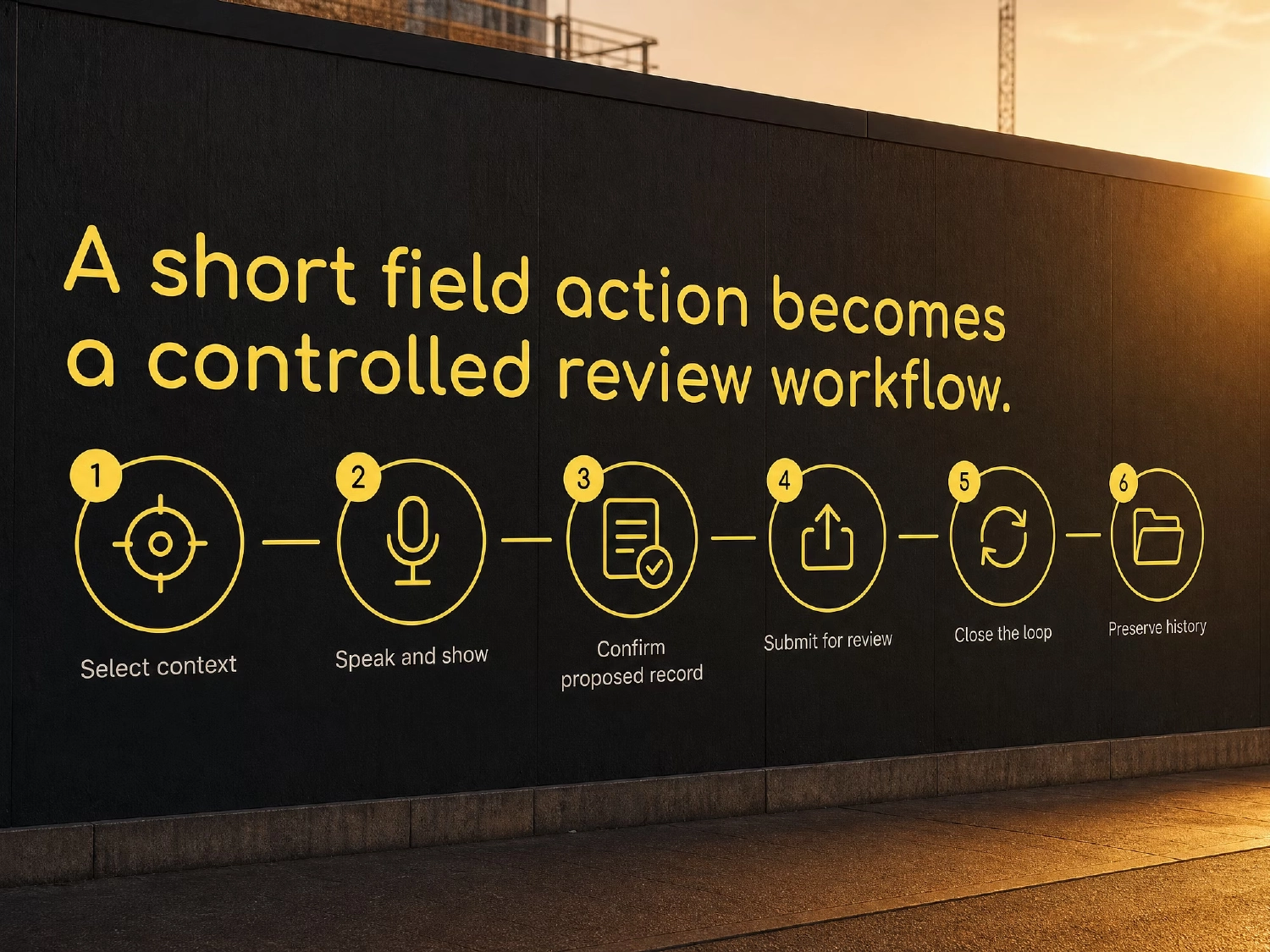
Review Workflow
How the accountable reviewer accepts, rejects, routes, or requests clarification on a structured packet.